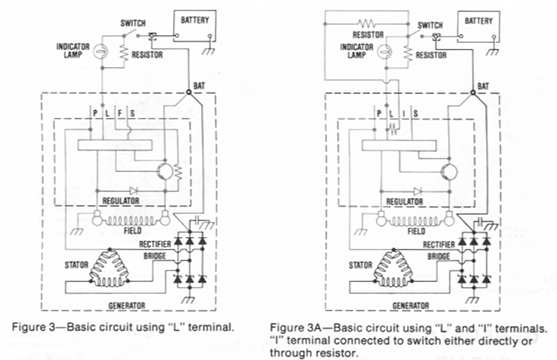
| A basic wiring diagram is shown in Figures
3 and 3A (above). When operating normally, the
indicator bulb will come on when the
switch is turned on, and will then go
out when the engine starts. If the
indicator operates abnormally, or if an under-charged or overcharged battery
condition occurs, the following procedure may be used to diagnose the
charging system. Remember that an undercharged
battery is often caused by accessories
being left on over-night, or by a defective switch which allows
a bulb, such as a trunk or glove box
light, to stay on. This alternator does
not have a regulator by-pass test hole. Observe the following procedure:
I. Visually check belt and wiring and load check battery .
II. Go to step V. for vehicles without charge indicator light.
III. With ignition switch on and engine stopped, light should
be on. If not, detach harness at
alternator, use fused jumper to ground
"L" terminal lead on harness.
Be very carefully to properly identify "L" terminal lead.
|
|
Grounding
"L" terminal should cause indicator light to light.
If lamp does not light, locate open
circuit between grounding lead and ignition switch. Bulb may be bad.
IV. Switch on, engine running at moderate
speed. Light should be off. If not, stop
engine, turn switch on, and detach
wiring harness at alternator.
A. If light goes off, replace or repair
alternator.
B. If light stays on, check for grounded
"L" terminal wire in harness.
V. Battery undercharged or over-charged.
A. Detach wiring harness connector from alternator.
B. With switch on, engine not running, connect voltmeter from ground to "L" terminal in wiring harness, and
to "I" terminal, if used. Wiring
harness may connect to either "L" or "I" or both.
C. Zero reading indicates open or grounded circuit between terminal and battery. Correct as required.
|
|
D. Re-connect harness connector to
alternator,
run engine at moderate speed with all electrical
accessories turned off.
E. Measure voltage across battery. If above 16.0, replace or repair
alternator. NOTICE: The alternator may be
O.K. on vehicles using "S"
terminal if "S" terminal wiring
has excessive resistance which will cause high voltage. Refer to vehicle wiring
diagram. Correct wiring as needed, then
re-check voltage.
F. Connect ammeter at alternator output terminal. Connect voltmeter across
alternator. Turn on accessories. load
battery with carbon pile to obtain
maximum amperes output. Maintain voltage
at 13.0 or above.
1. If within 15 amperes of rated output,
alternator is O.K.
2. If not within 15 amperes of rated
output. Check belt for slippage or replace or repair alternator.
Page 3....NEXT
PAGE>>>>> |